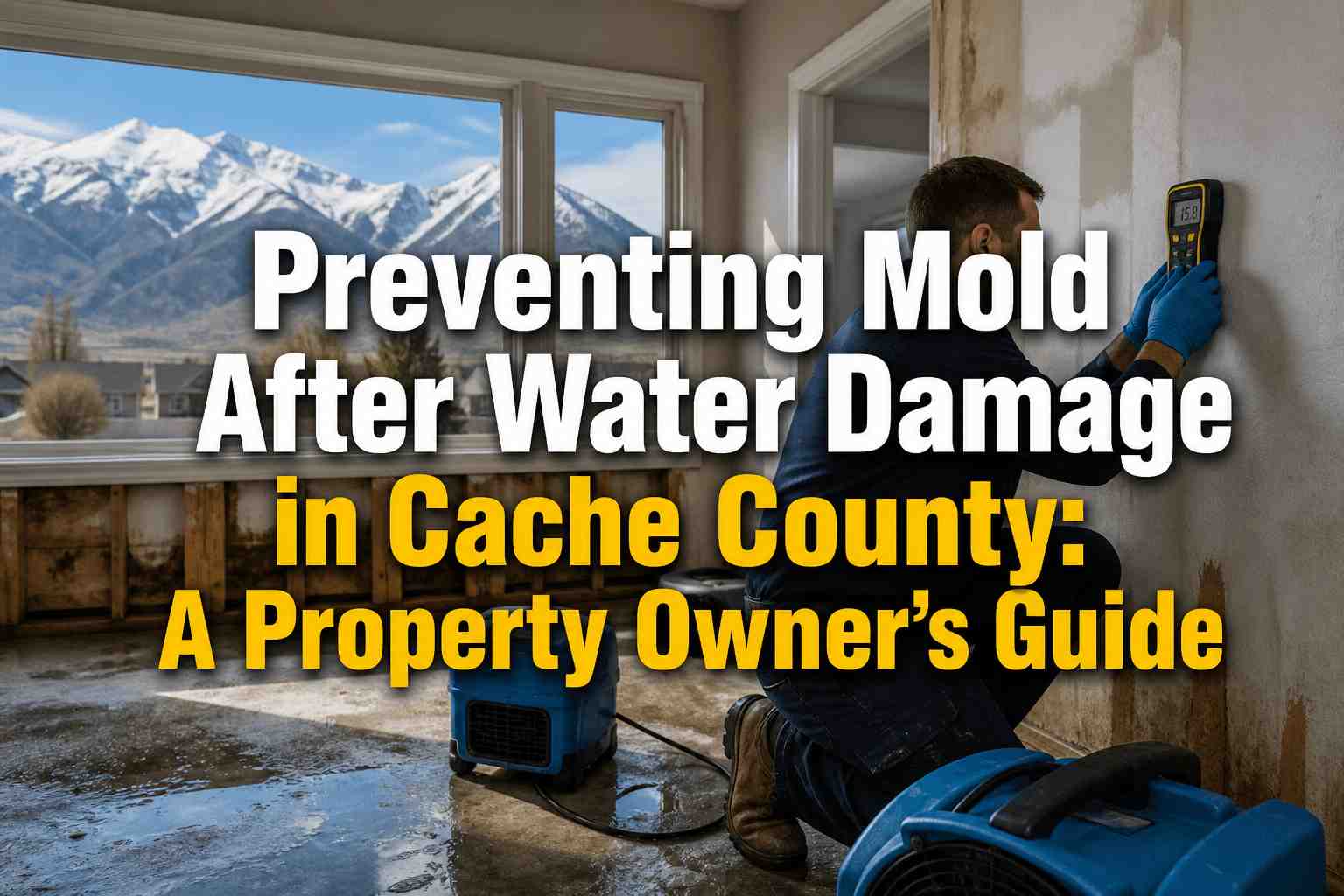
Preventing Mold After Water Damage in Cache County: A Property Owner’s Guide
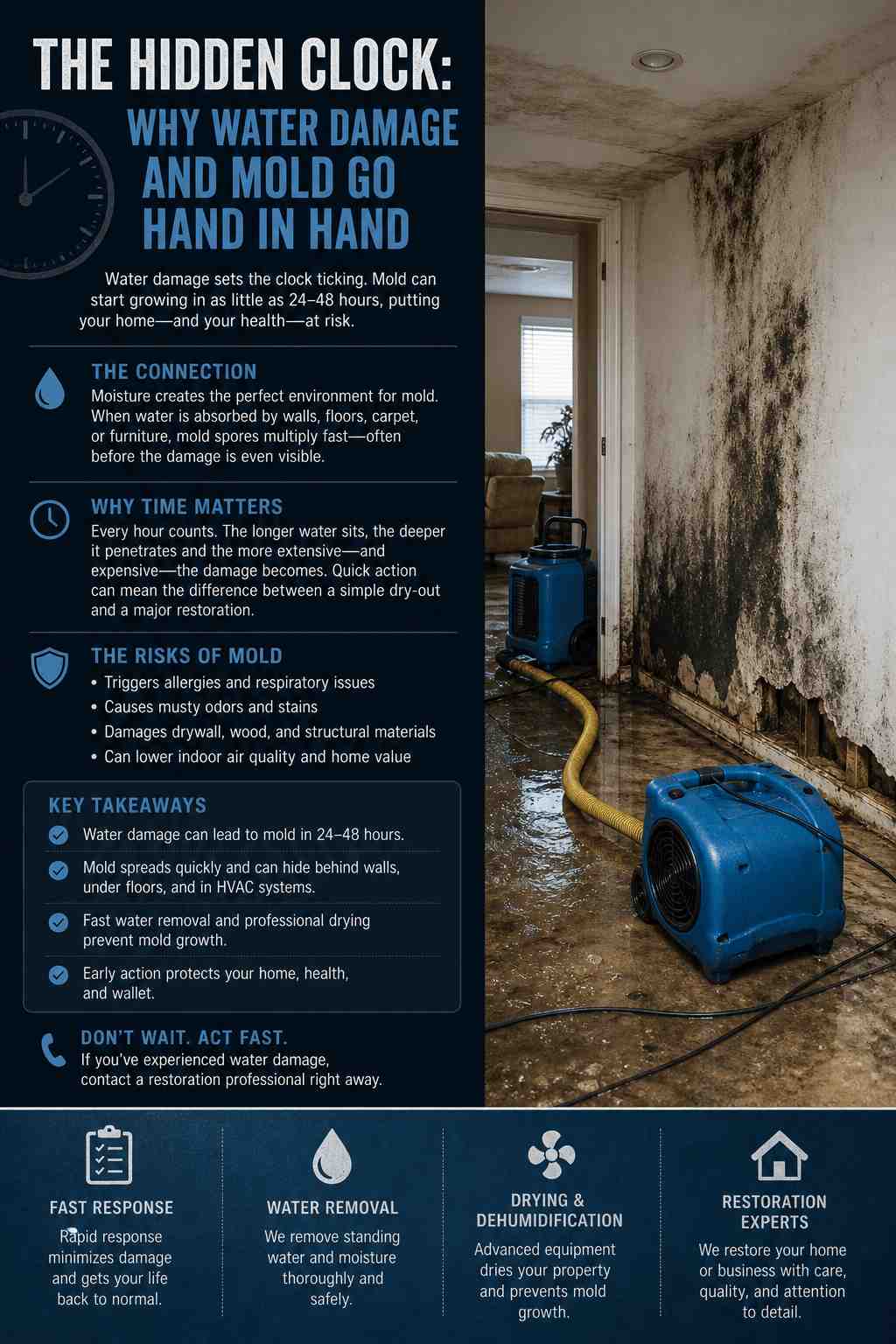
- The 24-to-48-Hour Window: Mold spores can germinate and begin to colonize wet building materials (especially drywall) in as little as 24 to 48 hours after water damage occurs.
- Why Drywall is Vulnerable: Drywall paper contains organic cellulose, which acts as a primary food source for mold when moisture is introduced.
- Hidden Dangers: Mold frequently grows unseen behind wet drywall and under carpets, making visual inspections alone highly unreliable.
- Professional Advantage: Industrial structural drying equipment and advanced moisture mapping are essential to thoroughly lower indoor humidity and prevent mold colony formation.
- Local Response Matters: Utilizing a locally owned and operated restoration team like Cache Restoration ensures rapid dispatch to mitigate seasonal Utah water damage
The Hidden Clock: Why Water Damage and Mold Go Hand in Hand
Discovering water in your crawl space, basement, or commercial warehouse is incredibly stressful. Whether it is a burst pipe during a freezing Logan winter or a sudden plumbing leak in a Hyde Park office, property damage demands immediate action. The biggest threat following any water intrusion isn’t just the standing water itself, it is the rapid, quiet onset of mold.
As a property owner, your immediate concern after water strikes should be mold prevention. Knowing how quickly mold can take hold, where it hides, and how local seasonal factors accelerate its growth can save you thousands of dollars in structural repairs and safeguard your indoor air quality.
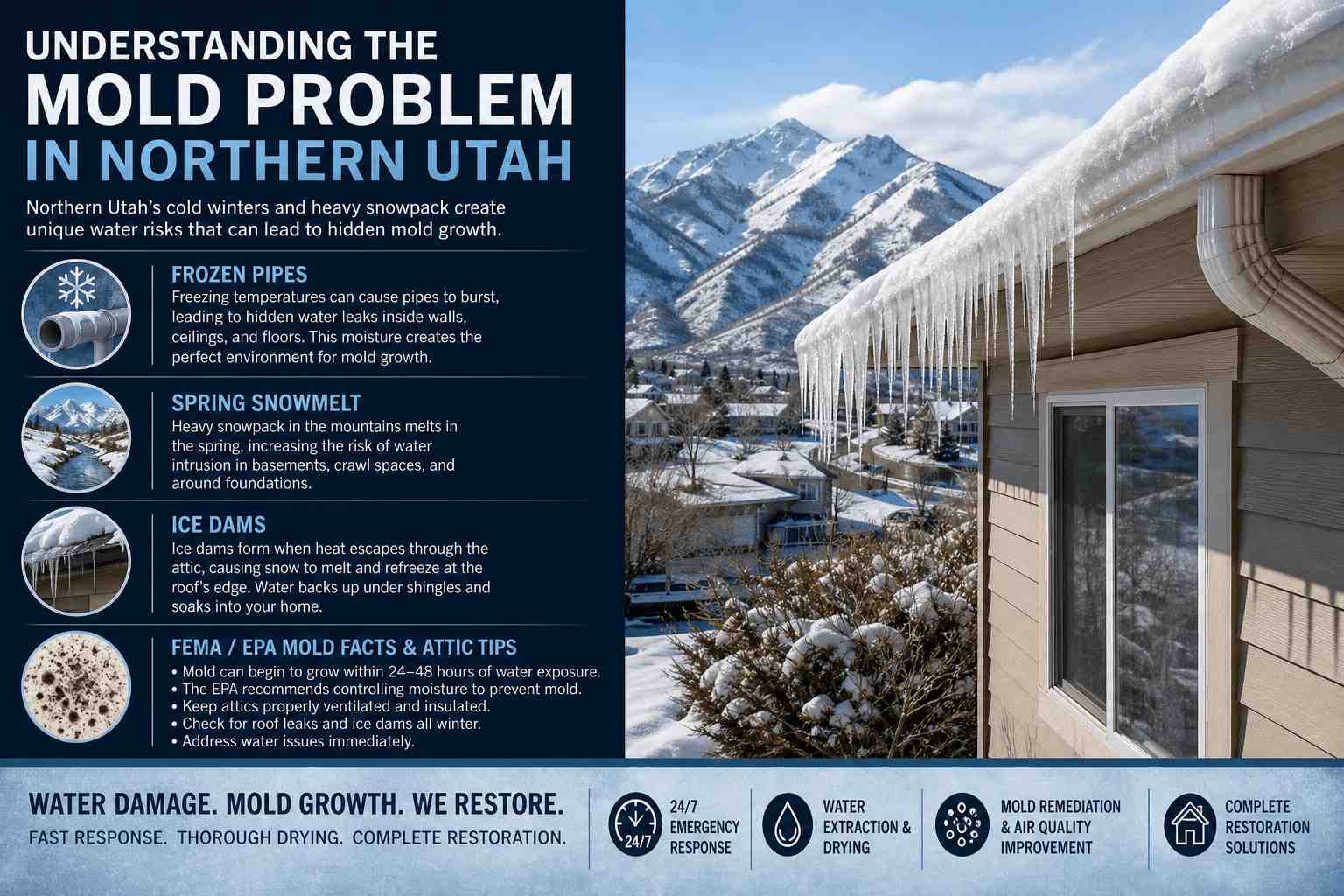
Understanding the Mold Problem in Northern Utah
Many people assume that Utah’s semi-arid climate protects properties from mold. While our summers are dry, our homes and commercial buildings are highly susceptible to moisture problems due to unique seasonal shifts in Cache County.
Common Causes of Water and Mold Damage
- Frozen Pipes: Sub-zero winter temperatures in places like Smithfield and Richmond easily freeze residential and commercial plumbing lines. When they thaw and burst, they release hundreds of gallons of water directly into walls and floor cavities.
- Spring Snowmelt and Basement Flooding: Rapid spring warming causes heavy mountain snowpack to melt, raising local water tables and flooding basements in low-lying areas like Nibley and Millville.
- Ice Dams: Heavy winter snow accumulation can create ice dams on roofs in Wellsville and Mendon, forcing water to back up under shingles and leak down into attic insulation.
Did you know? According to the Federal Emergency Management Agency (FEMA), mold can begin growing on wet surfaces in as little as 24 to 48 hours. If you’ve experienced water damage, the clock is ticking.
According to the Federal Environmental Protection Agency (EPA), mold spores exist naturally in indoor and outdoor air. However, they require moisture, a food source (like drywall paper, wood framing, or carpet padding), and moderate temperatures to grow. When water saturates these materials, mold spores germinate and colonize in as little as 24 to 48 hours.
Check Your Attic in Spring Ice dams can slowly drip water into your attic insulation all winter. Once temperatures rise, this damp, dark environment turns into a prime breeding ground for mold before you even realize a leak exists.
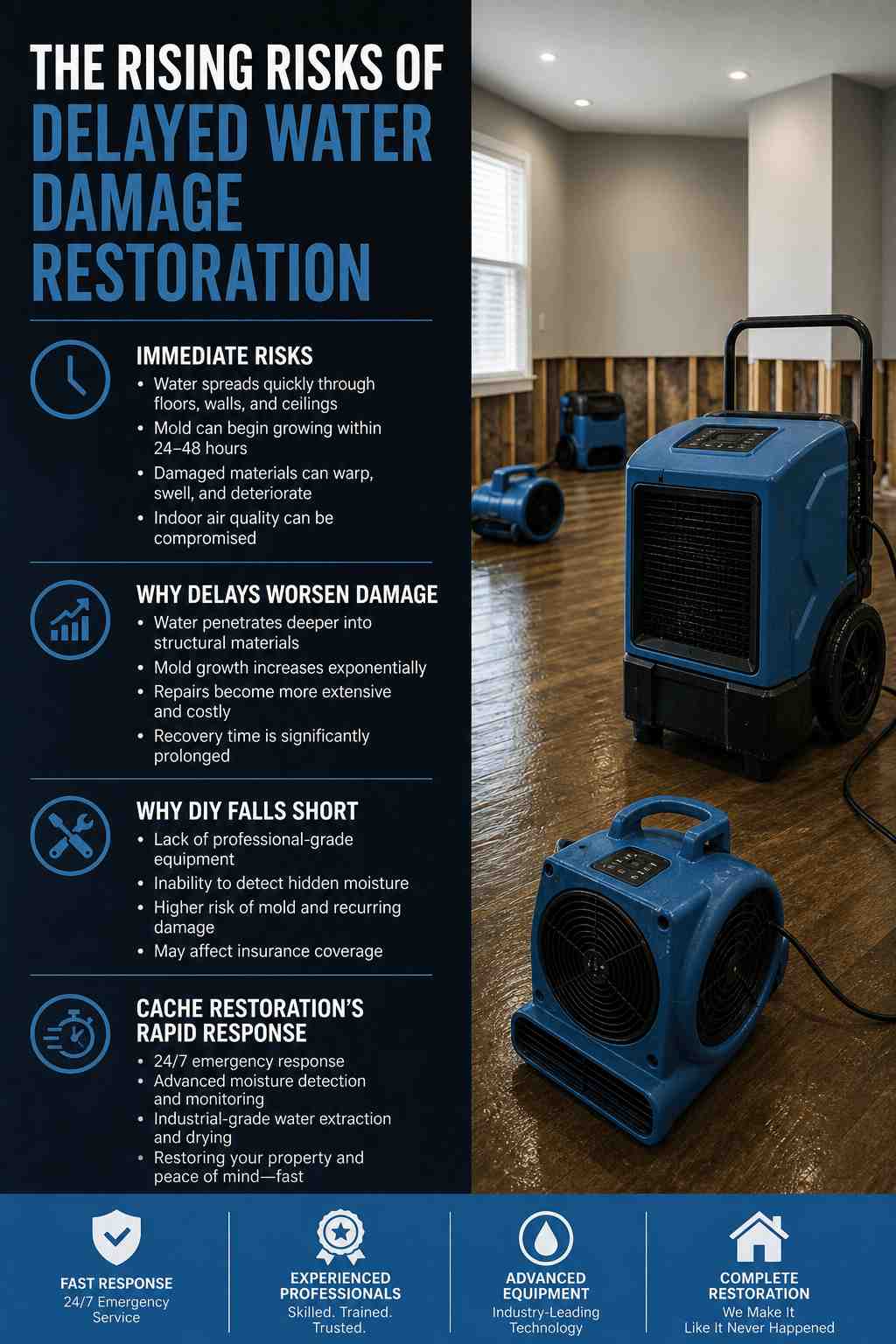
The Rising Risks of Delayed Water Damage Restoration
If water damage is ignored, or if drying is incomplete, mold is almost guaranteed to follow. Delaying cleanup by even a few days dramatically increases the scope and cost of recovery.
The Stages of Moisture Progression
- Immediate Risks: Standing water weakens building materials, swells laminate flooring, and ruins carpet fibers.
- Why Delays Worsen Damage: As wet materials remain damp, mold spreads behind baseboards, under vinyl flooring, and deep inside wall cavities. What began as a straightforward water extraction job quickly spirals into an extensive, costly mold remediation project.
- Why DIY Often Falls Short: Standard household fans and retail dehumidifiers simply lack the power to pull deep, structural moisture from dense materials like hardwood, plaster, and subfloors.
To prevent mold, you need precise moisture mapping and industrial-strength drying systems. Cache Restoration steps in immediately to arrest the drying process, monitoring relative humidity and moisture levels with advanced thermal imaging and moisture meters to ensure your home or business is completely dry before mold has a chance to establish itself.
DIY vs. Professional Restoration
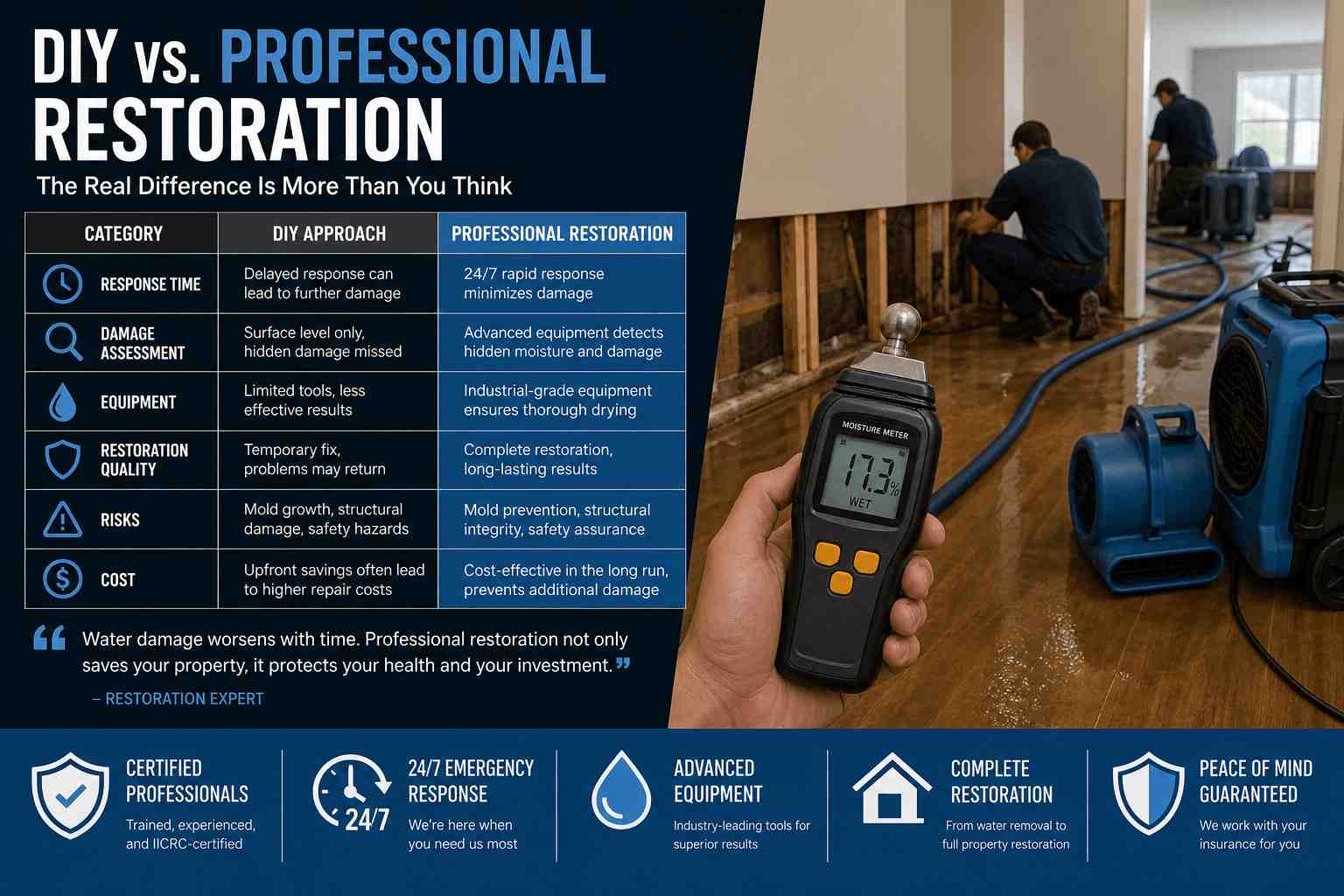
When water strikes, it is tempting to rent a couple of carpet fans and handle the cleanup yourself. However, the risks of missing hidden moisture are high. Let’s compare the two approaches:
|
Feature |
DIY Cleanup |
Cache Restoration Professional Service |
|
Moisture Detection |
Visual inspection (misses water behind walls) |
Advanced infrared cameras and invasive moisture meters |
|
Drying Power |
Household fans (circulate damp air slowly) |
High-speed air movers and industrial LGR dehumidifiers |
|
Mold Prevention |
Low (humidity remains high, leading to mold) |
High (rapidly lowers relative humidity below mold-growth levels) |
|
Documentation |
Handwritten notes or basic photos |
Comprehensive structural drying logs for insurance claims |
Expert Quote: “Proper drying isn’t just about what feels dry to the touch. True drying requires bringing structural materials back to their pre-loss moisture standards using balanced thermodynamics. If you don’t control the indoor relative humidity, mold will find a home.” – Certified Restoration Specialist
Cache Restoration Services
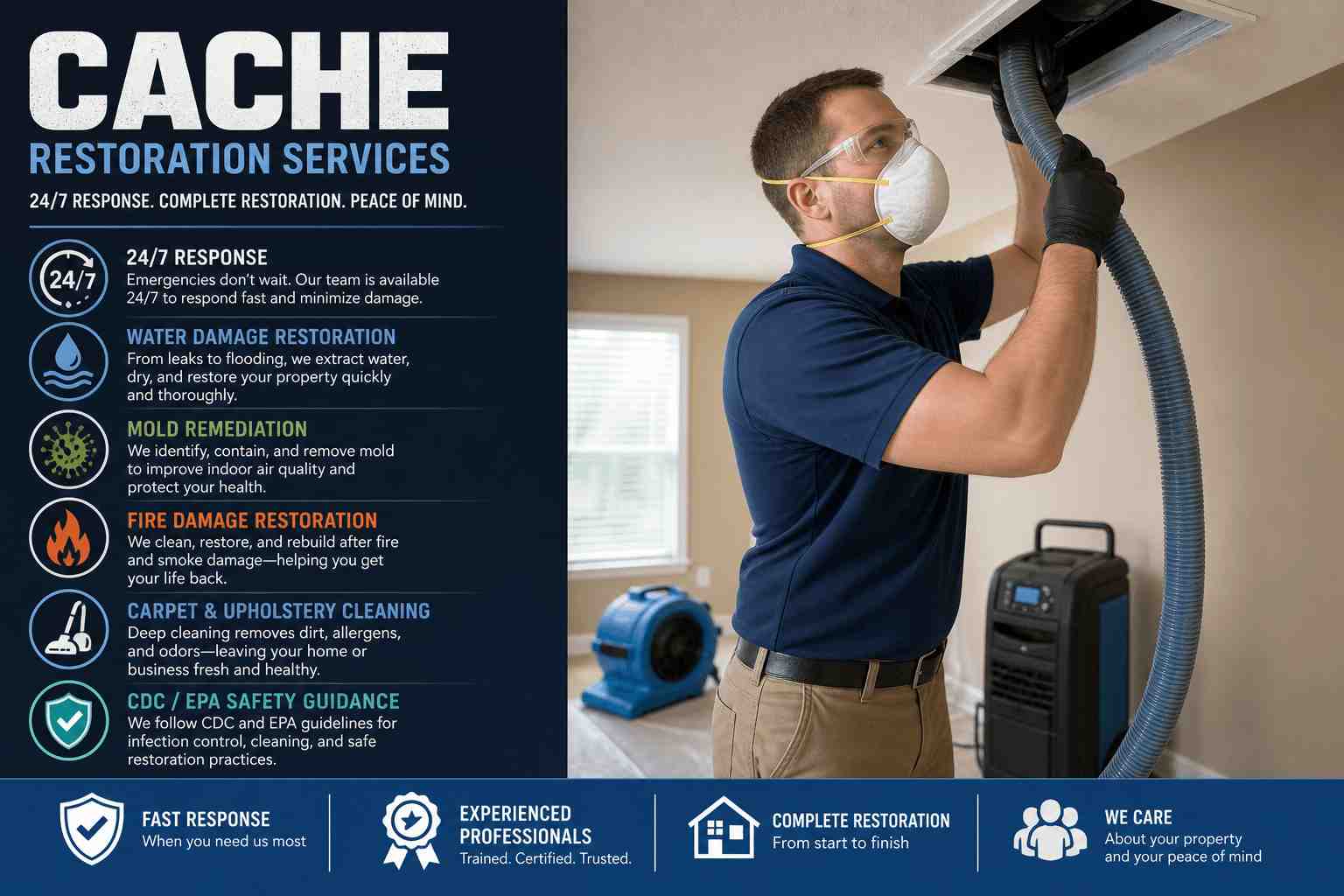
When disaster strikes, you need a local partner who can respond rapidly with professional-grade solutions. Cache Restoration provides comprehensive recovery services to protect your property:
- 24/7 Emergency Response: Disaster doesn’t wait for business hours. We provide rapid local dispatch day or night to stop water in its tracks.
- Water Damage Restoration Cache County: Our team extracts standing water, sets up advanced drying equipment, and monitors progress until your property is completely dry.
- Mold Remediation: If mold has already taken hold, we follow strict containment and remediation protocols to safely remove the mold and restore healthy indoor air quality.
- Fire & Smoke Damage Restoration: We clean soot, neutralize corrosive smoke residues, and completely eliminate smoke odors.
- Professional Carpet Cleaning: We restore stained, damp, or worn carpets to extend their life and improve your home’s cleanliness.
The Local Advantage Unlike national franchises, our team is based right here in Cache Valley. We live in your neighborhood, understand the local climate, and can be on-site at your home or business in minutes to start the mitigation process.
Safety & Property Protection
Protecting your property goes hand-in-hand with protecting your family’s health. The Centers for Disease Control and Prevention (CDC) and the Environmental Protection Agency (EPA) warn that indoor mold exposure can trigger nasal stuffiness, throat irritation, coughing, wheezing, and more severe respiratory symptoms in sensitive individuals.
Our local, highly trained professionals prioritize structural integrity and safety. By rapidly eliminating moisture, we protect your indoor air quality, stop mold spores from spreading through your HVAC system, and save structural components from wood rot. Furthermore, we handle the documentation and coordinate directly with your insurance adjuster to ensure your claim is processed smoothly, taking the burden of stress off your shoulders.
Proactive Prevention Tips for Cache County Homeowners
The best way to handle water and mold damage is to prevent water from entering your property in the first place.
- Winterize Your Pipes: Before freezing temperatures hit Logan and North Logan, insulate exterior hose bibs and wrap pipes in unheated crawl spaces or basements.
- Clear Your Gutters: Ensure gutters are clear of fall leaves so melting snow and spring rains route far away from your foundation.
- Monitor Indoor Humidity: Keep indoor humidity levels between 30% and 50% using exhaust fans in kitchens and bathrooms.
- Inspect Appliance Hoses: Check washing machine, dishwasher, and refrigerator water lines annually for cracks or slow leaks.
- Install a Sump Pump: If you live in high-water-table areas like Providence or Hyrum, ensure you have a functioning sump pump with a battery backup.

Conclusion
When water damage occurs, the clock is ticking against mold growth. While mold is highly likely to develop on wet building materials within 48 hours, acting quickly can completely prevent it. Relying on a locally owned and operated company like Cache Restoration ensures you get a rapid, personalized, and empathetic response from neighbors who understand Cache County’s unique seasonal challenges.
Unlike national franchises, Cache Restoration proudly serves homeowners and businesses throughout Cache County, including Logan, North Logan, Smithfield, Hyde Park, Providence, Hyrum, Wellsville, Richmond, Mendon, Millville, Nibley, Paradise, and surrounding communities.
If you are dealing with water damage, don’t wait for mold to start. Contact Cache Restoration today for trusted, local, and professional 24/7 emergency restoration services.
Frequently Asked Questions
Does homeowners insurance cover mold remediation?
In most cases, standard homeowners insurance policies cover mold remediation only if the mold is a direct result of a “sudden and accidental” water event, like a burst pipe. Gradual damage from unresolved maintenance issues or long-term slow leaks is typically excluded.
Can soaked carpets and padding be saved?
If the water is clean (such as from a supply line leak) and professional water damage restoration begins within 24 to 48 hours, carpets can often be sanitized, dried, and saved. However, the underlying carpet padding acts like a sponge and usually must be replaced. If the water is contaminated (sewage or groundwater), the carpet and pad must be discarded for safety reasons.
How long does the drying and restoration process take?
On average, the structural drying phase takes between 3 to 5 days. Factors that influence this timeline include the volume of water, the types of building materials affected, and how quickly professional restoration equipment is deployed.
Category 3 (Black) Water is Always a Discard Water from sewage backups, rivers, or outdoor flooding carries hazardous pathogens. Carpets, pads, and drywall touched by Category 3 water must be cut out and discarded immediately, regardless of drying times.
How likely is mold after water damage?
If wet structural elements or belongings are left wet for more than 24 to 48 hours, mold is highly likely to grow. Spores thrive on organic building materials like drywall and wood once a moisture source is introduced.
How likely is mold after water damage?
If wet structural elements or belongings are left wet for more than 24 to 48 hours, mold is highly likely to grow. Spores thrive on organic building materials like drywall and wood once a moisture source is introduced.
How long does it take for water damage to turn to mold?
Under typical indoor conditions, mold spores can germinate and begin to colonize within 24 to 48 hours of water exposure. Visible growth and structural damage can develop in as little as 72 hours.
How long can drywall be wet before mold grows?
Drywall can generally remain wet for up to 24 to 48 hours before mold spores begin to colonize. Because drywall is made of organic paper backing, it acts as an ideal food source for mold when saturated.
Is water damage always followed by mold?
No, water damage does not automatically lead to mold if the moisture is extracted and the structural materials are professionally dried within 24 to 48 hours. If the drying process is delayed or incomplete, however, mold is nearly guaranteed.
What should I spray to prevent mold after water damage?
You can spray EPA-registered fungicides or antimicrobial disinfectants designed for water damage restoration. Avoid using household bleach, as it does not penetrate porous surfaces like drywall and wood, leaving the deep mold roots alive.
How do I check for mold after water damage?
You can check by looking for discolored patches, smelling for musty odors, and using specialized moisture meters or thermal imaging cameras. Professional inspections by companies like Cache Restoration are the most reliable way to find hidden mold.
How can I tell if mold is growing behind my drywall?
Signs of hidden mold include persistent musty odors, water staining, soft spots on the wall surface, or peeling paint and wallpaper. A professional restoration team can inspect inside the wall cavities safely without spreading dangerous spores throughout your home.
When should I call a professional restoration company?
You should call a restoration company immediately after discovering any significant water intrusion or leak. Getting professional extraction and drying equipment on-site within the first 24 hours is the single best way to prevent mold.
Does drying wet carpet prevent mold?
Drying the surface carpet fibers helps, but mold often grows in the underlying carpet pad or subfloor which dries much slower. Professional water extraction and deep drying of both the carpet and pad are required to guarantee mold prevention.
Can mold grow in dry climates like Utah?
Yes, while Cache County has a dry climate, the indoor environment of a water-damaged property provides the perfect warm, humid microclimate that mold needs to thrive. Indoor water leaks bypass the dry outdoor weather completely.