Salt Stains on Carpet: How to Handle Winter Salt in Cache Valley?
Key points
-
- Salt dissolves in water, so the fix is to blot, rinse, and extract it, not scrub it.
- Leftover residue is why white lines return and why carpet re-soils fast.
- Spot test first, and use small amounts of water so the backing stays dry.
- Call a pro if the stain keeps coming back, covers a large area, or the carpet stays damp.
- A mat system at the door stops most salt before it reaches the carpet.
Introduction
Salt stains on carpet come out when you dissolve the salt with plain water, blot it up, and dry the spot fast. Scrubbing or dabbing with a cleaner alone usually just moves the residue around. Cache Valley winters mean months of salt and grit tracked through the door, so entryways and hallways take the worst of it.
This guide covers why salt leaves white lines, the safe method to try at home, what to avoid, and when it makes sense to call a local carpet cleaner like Cache Restoration in Richmond.
Why does winter salt leave white stains and make carpet look dirty again?
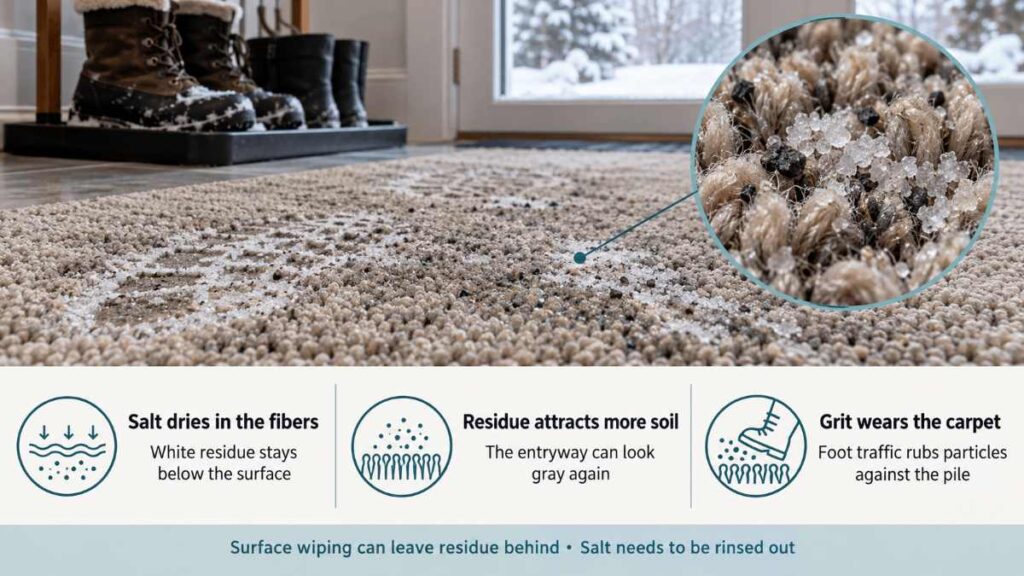
Salt stains are the dried residue of de-icer that melted off your boots, and it stays in the carpet pile until it is rinsed out. Wiping the surface removes some of it, but the rest sits deeper in the fibers.
Utah State University Extension lists rock salt, calcium chloride, and magnesium chloride among common de-icing products, and notes that the chlorides can leave a slippery film on surfaces. A trade article from Cleanfax adds that leftover residue can reappear as a white powder and make carpet pick up soil quickly again. That is why a carpet can look clean for a week and then gray at the door.
Road grit travels in with the salt. It is abrasive, so a gritty entryway wears on the pile as people walk over it.
How do you remove salt stains from carpet at home?
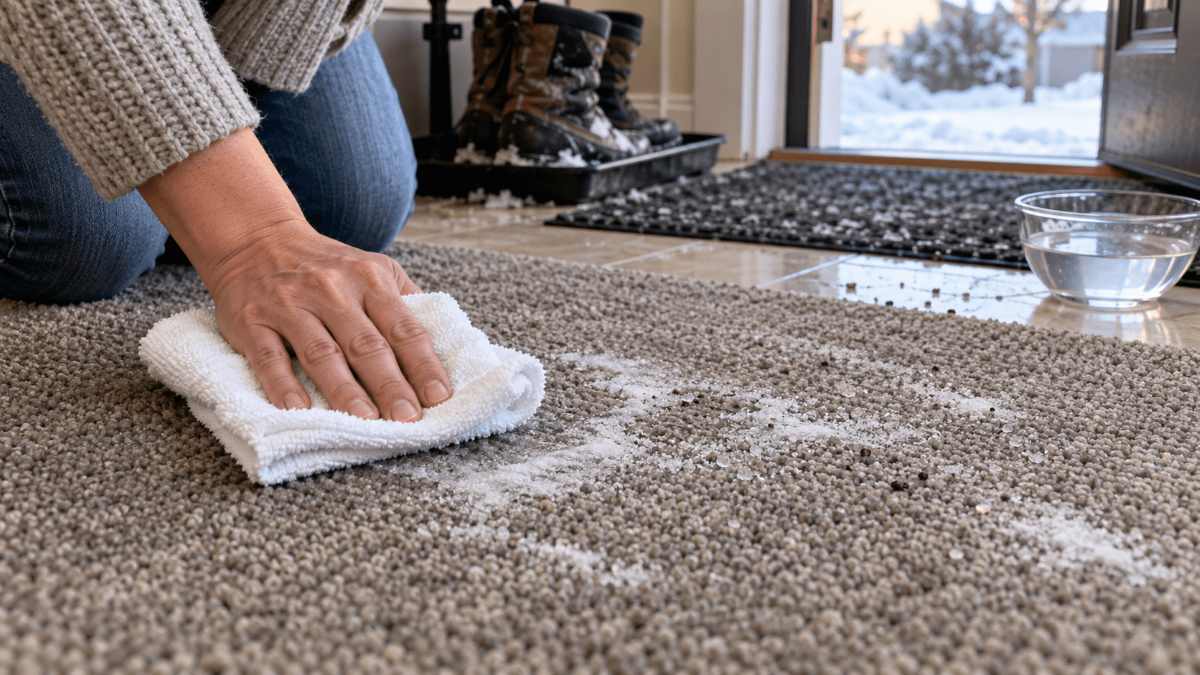
To remove salt stains from carpet, vacuum the dry area, then dab it with plain warm water on a white cloth, blot, and repeat until the cloth stays clean. Rinse with clean water, pull the moisture out with a wet-vac if you have one, and dry the spot quickly with a fan.
-
- Vacuum dry first. This lifts loose grit and salt crystals so you are not grinding them into the pile.
- Spot test. Try the water in a hidden corner, such as inside a closet, and stop if any color moves.
- Dab, do not rub. Use a white cloth and warm water, working from the outside of the stain toward the center. Some guides add white vinegar mixed 1:1 with water; test that first too.
- Blot with a dry towel. Press firmly and lift. Switch to a clean section of towel often.
- Rinse and extract. Dab with clean water to flush what is left, then pull the moisture out with a wet-vac. A towel with weight on top works for small spots.
- Dry fast. Point a fan at the spot, then vacuum once it is fully dry.
Expert tip: Use less water than you think you need. A soaked carpet pad or backing is a bigger problem than a salt line, and it takes far longer to dry. Blotting is better than scrubbing, which also protects the fibers.
What should you not do with salt on carpet?
Do not scrub, do not soak, and do not reach for laundry detergent. Each one makes the stain harder to remove.
-
- Scrubbing pushes salt deeper and can fuzz or distort the fibers.
- Laundry detergent leaves its own residue behind, and the carpet industry advises against it.
- Over-wetting soaks the pad and backing, which slows drying and can leave a musty smell.
When is a professional carpet cleaning worth it?
Call a pro when white lines keep coming back, salt covers a large area, the carpet stays damp, or the fibers look matted or discolored. Those are signs the salt is deeper than a spot treatment can reach.
Hot water extraction flushes the whole pile and pulls the dissolved salt out with the water, which is the step a cloth and a spray bottle cannot match. Cache Restoration uses a steam method with no soap, followed by a second pass with a drying wand.
You can see how the work is done on our carpet cleaning page. If price is the question, our guide to carpet cleaning cost in Cache Valley (link the article Carpet Cleaning Cost in Cache Valley: What to Expect here once live) explains what changes the number.
How often should entryway carpet be cleaned? The Carpet and Rug Institute suggests every 12 to 18 months for most homes, while heavy-traffic and winter-salt areas may need it sooner.
How do you keep salt out of your carpet this winter?
Stop the salt at the door with a layered mat system, and take your shoes off inside. Most of what ends up in the carpet comes in on the soles of boots.
-
- Scraper mat outside. A coarse mat knocks the packed salt and grit off before anyone steps in.
- Absorbent mat inside. A second mat catches what the first one missed and holds the melted slush.
- Boot tray and a shoes-off rule. Give wet boots a place to sit that is not the carpet.
- Vacuum on a schedule. The Carpet and Rug Institute suggests vacuuming entry areas weekly and busy areas daily.
Expert tip: Shake out or vacuum the mats too. A mat full of salt just hands it to the next pair of boots.

Conclusion
Salt stains on carpet come out of carpet with patience and plain water: dissolve it, blot it, rinse it, and dry it fast. If the white lines keep returning, the salt is deeper than a spot treatment can reach.
Cache Restoration can take a look at stubborn entryway salt and tell you whether a professional clean is worth it. Call (435) 787-7007 or request a free estimate before the worst of winter sets in.
Frequently Asked Questions
How do you get salt stains out of carpet?
Vacuum dry, dab with plain warm water, blot, rinse and extract, then dry fast with a fan. Spot test first and use as little water as you can.
Does vinegar remove salt stains from carpet?
Some guides use a 1:1 mix of white vinegar and water. Plain water often works as well, so spot test either one in a hidden spot first.
Why do salt stains keep coming back after cleaning?
Salt left in the pile wicks back to the surface as the carpet dries. Rinsing and extracting, not just blotting, is what removes it.
Can road salt permanently damage carpet?
Left in place, salt residue and grit can leave lasting marks and a rough, gritty feel. Prompt cleaning lowers the risk.
Should I vacuum before treating a salt stain?
Yes. Vacuuming first lifts loose grit and crystals so you do not rub them into the fibers while you work.
How often should I clean entryway carpet in winter?
Vacuum entry areas weekly and busy areas daily, per the Carpet and Rug Institute. Professional cleaning timing depends on traffic.
Can I use a steam cleaner or rented machine on salt stains?
Yes, if you rinse with clean water and extract well. Skip extra soap, which leaves its own residue, and do not over-wet the carpet.
Is rock salt or ice melt worse for carpet?
Both leave residue. Calcium and magnesium chloride products can leave a slippery film, according to USU Extension.
How much does professional salt removal cost?
Price depends on the area, the amount of salt, and the carpet type. Our carpet cleaning cost guide breaks down what changes the number.
How do I protect carpet from salt in winter?
Use a scraper mat outside, an absorbent mat inside, a boot tray, and a shoes-off rule. Vacuum entry areas often.