Beyond Cleanup: The True Purpose of a Disaster Restoration Company
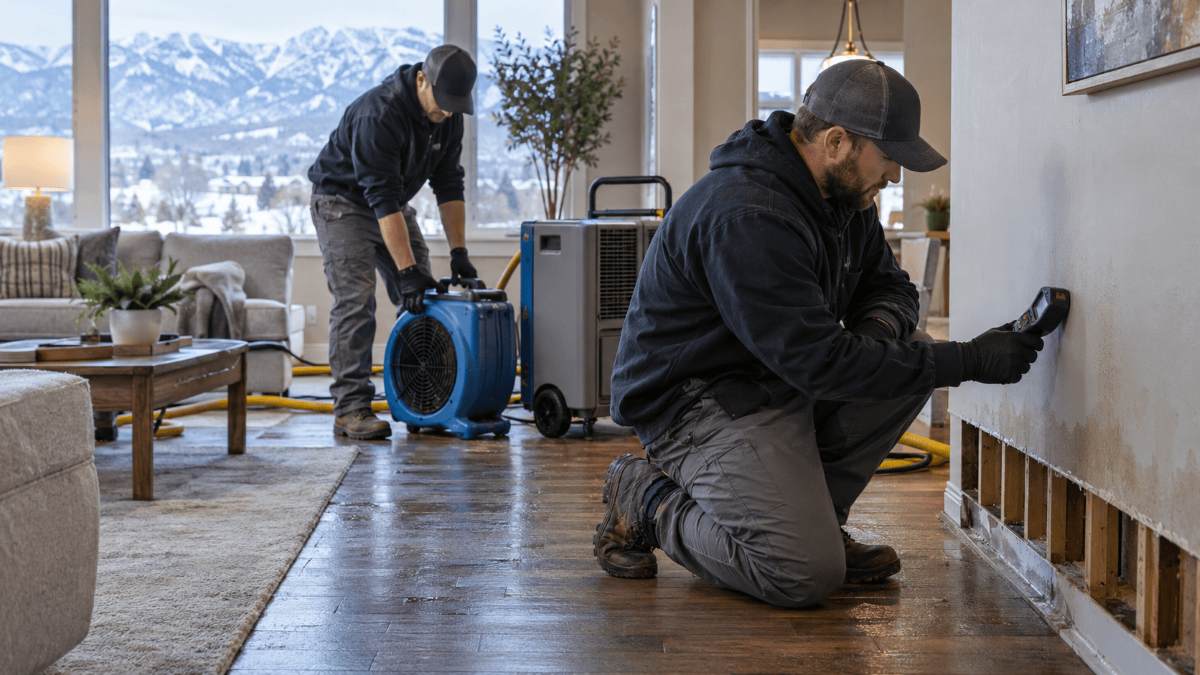
- Immediate action saves properties: Professional restoration is a highly specialized science that goes far beyond basic cleaning to prevent permanent structural loss.
- Time is the ultimate enemy: Water, fire soot, and mold degrade building materials exponentially; waiting even 24 hours can double recovery costs.
- Local expertise matters: Understanding Cache County’s unique climate from freezing winter drafts to rapid spring snowmelt is essential for effective property drying and repair.
- A seamless path to recovery: Certified experts handle everything from structural stabilization and advanced drying to directly navigating complex insurance claims.
When Disaster Strikes Your Cache County Property
No property owner is ever fully prepared for the gut-wrenching feeling of stepping into a flooded basement or a smoke-damaged office. Whether it is a sudden pipe burst during a freezing winter night in Logan or a commercial roof leak caused by heavy spring snowmelt in Smithfield, property damage brings immediate stress, confusion, and disruption.
When your home or business suffers sudden damage, the road to recovery can feel overwhelming. Many owners assume that a mop, a few household fans, and some bleach are enough to handle the aftermath. However, property damage is rarely just on the surface.
This is where a professional disaster restoration team becomes your most valuable asset. Utilizing advanced structural drying, smoke neutralization, and certified microbial remediation, a restoration company does not just clean up the mess, they save your property from permanent structural failure.
Why Cache Valley Properties Face Unique Risks
Living and doing business in the beautiful Cache Valley means preparing for distinct seasonal hazards. Unlike national franchise operations that use one-size-fits-all drying formulas, a local restoration team understands exactly how our specific Utah climate affects residential and commercial building materials.
Seasonal Factors and Structural Vulnerabilities
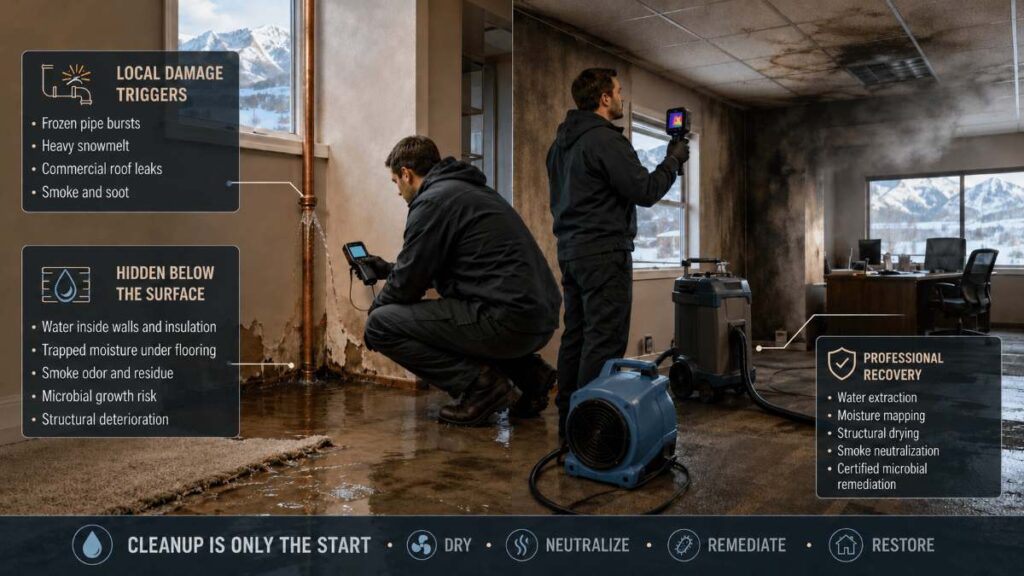
- Sub-Zero Utah Winters: When temperatures plunge, water lines running through exterior walls or uninsulated crawl spaces in historic Hyde Park or Mendon homes are highly vulnerable to freezing. When these pipes burst, hundreds of gallons of pressurized water can flood a structure in minutes.
- Heavy Snow Accumulation & Ice Dams: Heavy snow loading on roofs can cause structural sagging. As heat escapes from the attic, it melts the underside of the snow cover, creating ice dams at the roof edges that force water backward under shingles, damaging ceilings and walls.
- Rapid Spring Snowmelt: As the winter snowpack in the surrounding Bear River Range melts, local water tables rise rapidly. This often triggers severe basement flooding and crawl space dampness across lower-elevation areas like Nibley and Wellsville.
- Summer Thunderstorms & Flash Flooding: Sudden, intense summer cloudbursts can easily overwhelm local storm drains, sending muddy exterior runoff directly into commercial storefronts and garden-level apartments.
- Wildfire Smoke & Low Humidity: Late summer wildfires in Utah can carry toxic smoke particles into local neighborhoods. This fine soot and ash settle into HVAC systems and soft textiles, requiring professional smoke damage cleanup to protect indoor air quality.
What is the True Purpose of a Restoration Company?
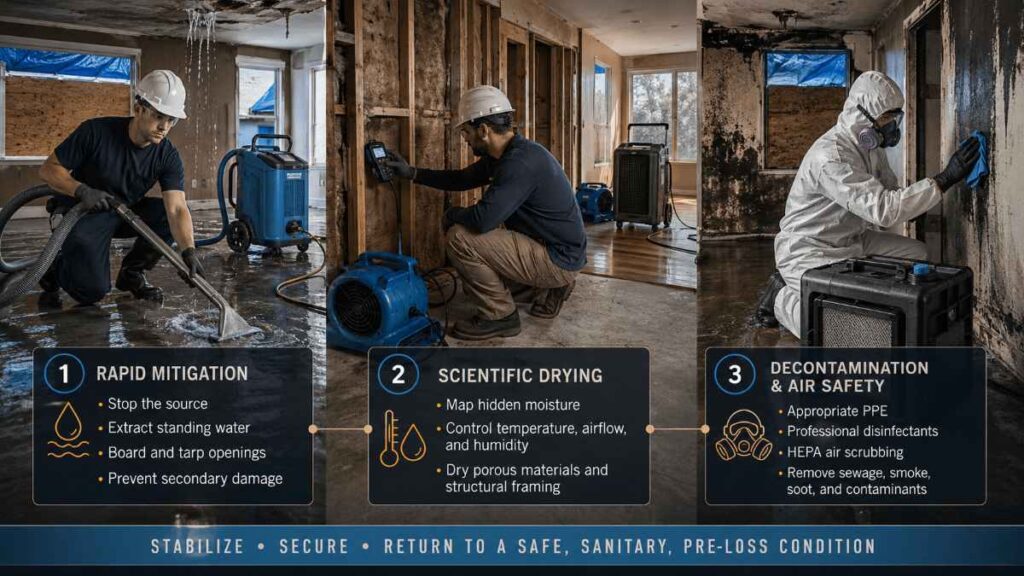
At its core, the purpose of a disaster restoration company is to stabilize, secure, and return a damaged property to a safe, sanitary, and pre-loss condition as quickly as possible.
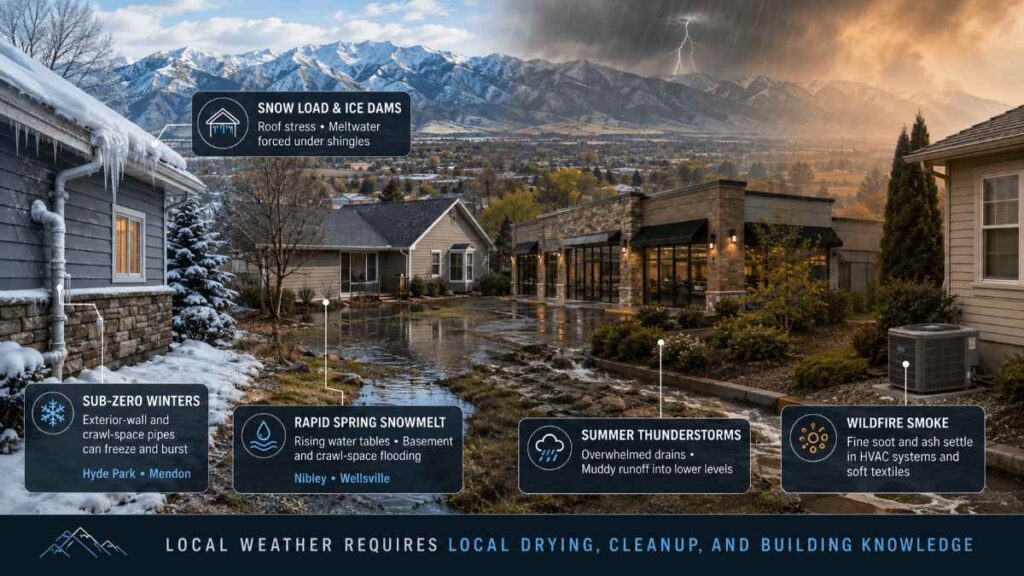
While a traditional cleaning service sweeps up dirt and washes surfaces, a certified restoration professional addresses the deep, hidden, and invisible aftermath of a disaster.
1. Rapid Mitigation (Stopping Active Damage)
The very first priority of Cache Restoration is to halt active damage. If water is actively pouring from a ceiling, we locate the source, stop the intrusion, and immediately begin high-capacity water extraction. If fire has compromised a roof or broken windows in a commercial building, we board up and tarp the structure to prevent secondary damage from weather or vandals.
2. Scientific Drying & Psychrometry
Drywall, concrete, and hardwood are highly porous materials. When they absorb water, they do not dry out easily on their own. Professionals use the science of psychrometry (the study of moist air and thermodynamic properties) to manipulate temperature, airflow, and relative humidity. This ensures moisture is drawn out from deep within structural framing before wood rot or warping occurs.
3. Decontamination and Health Safety
Water from broken sewer lines or outdoor street flooding carries dangerous pathogens, bacteria, and industrial chemicals. Fire soot contains highly toxic compounds and carcinogens that can lodge deep within lungs if not properly scrubbed from the air. A restoration company utilizes specialized personal protective equipment (PPE), botanical disinfectants, and HEPA air scrubbers to make your indoor air clean and safe to breathe.
Navigating the Insurance Claims Process Smoothly
Dealing with property damage is stressful enough without the added headache of deciphering complex insurance policies. Fortunately, property owners do not have to handle this administrative burden alone. A core advantage of partnering with Cache Restoration is our comprehensive insurance claim assistance.
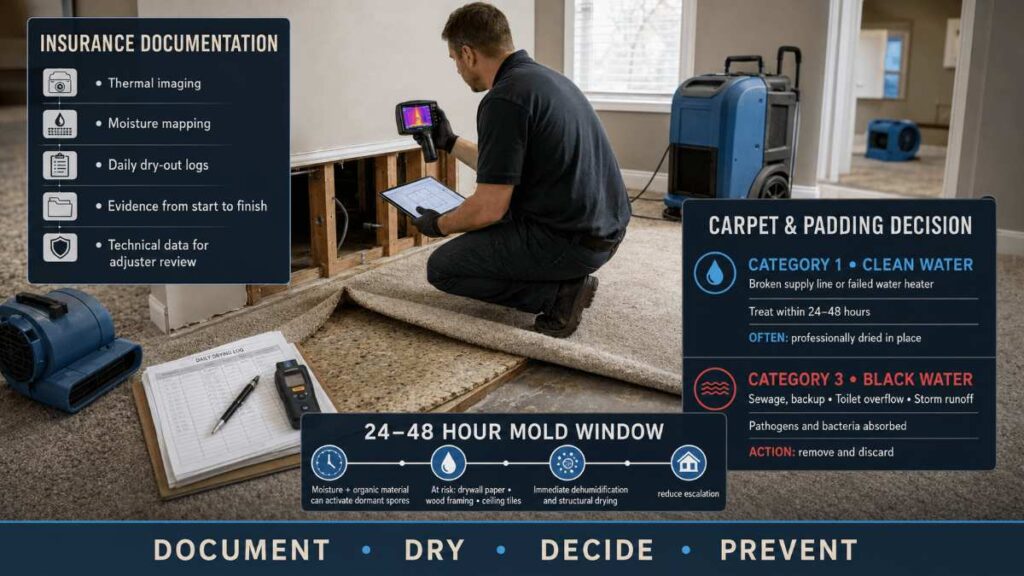
Instead of leaving you to guess what your insurance adjuster needs, our certified technicians document the entire mitigation process from start to finish. Using advanced thermal imaging, moisture mapping, and detailed daily dry-out logs, we build a highly precise, evidence-based file. This transparent documentation provides adjusters with the exact technical data they require to approve, process, and expedite your claim without unnecessary delays.
Salvaging Water-Soaked Carpets and Padding
Many property owners assume that once a carpet is thoroughly soaked, it is destined for the landfill. In reality, whether a carpet and its underlying padding can be saved depends entirely on the cleanliness of the water source, as outlined by the IICRC S500 standard.
- Category 1 (Clean Water): If the water comes from a clean source like a broken water supply line or a failed water heater and is treated within 24 to 48 hours, the carpet and padding can usually be safely dried in place using professional-grade extraction and dehumidification.
- Category 3 (Black Water): If the flooding involves unsanitary water such as sewage backups, toilet overflows, or outdoor storm runoff the carpet and padding absorb dangerous pathogens and bacteria. To protect the health of your family or employees, these materials cannot be salvaged and must be carefully removed and discarded.
The Critical Window for Mold Prevention
When water intrudes into an indoor environment, a silent countdown begins. Mold spores exist naturally in the air, but they remain dormant until they find moisture and an organic food source, such as the paper backing on drywall, wood framing, or ceiling tiles.
Under typical indoor temperatures, mold spores can germinate and begin actively colonizing in as little as 24 to 48 hours. Once mold takes root, it begins to degrade structural materials and release airborne allergens. This tight window is the primary reason why immediate, professional-grade dehumidification and structural drying are so critical; waiting even a single day to address dampness drastically increases the likelihood of needing extensive mold remediation later.
DIY vs. Professional Restoration
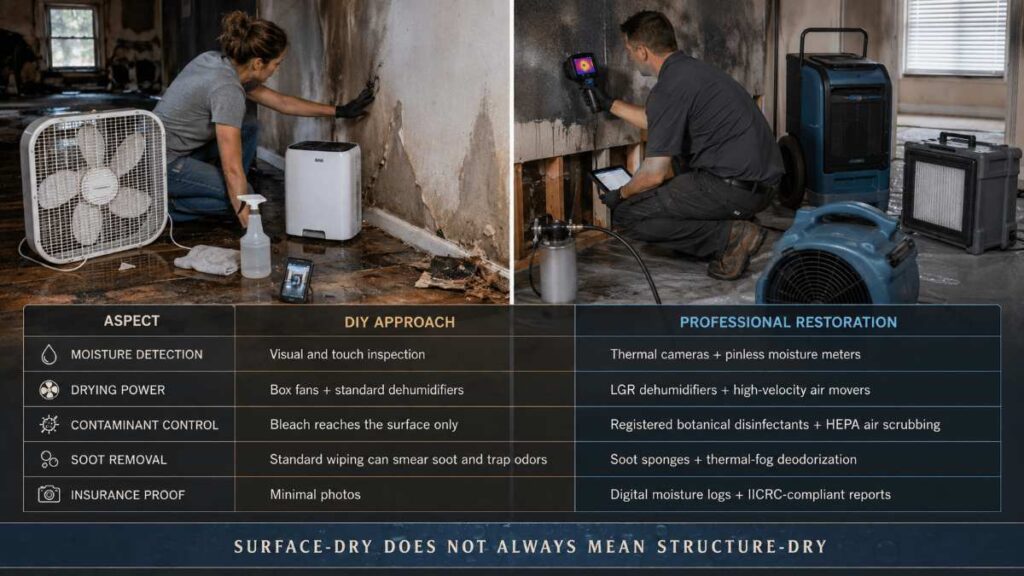
Many homeowners and property managers are tempted to handle minor floods or smoke damage themselves to save money. However, what looks dry on the surface is often holding pockets of trapped moisture underneath, leading to structural instability and hidden mold.
|
Aspect |
DIY Approach |
Cache Restoration |
|
Moisture Detection |
Visual and touch inspection (highly unreliable) |
Specialized thermal cameras and pinless moisture meters |
|
Drying Power |
Household box fans and standard dehumidifiers |
Industrial-grade LGR dehumidifiers and high-velocity air movers |
|
Contaminant Control |
Bleach sprays (which do not kill deep mold roots on porous materials) |
EPA-registered botanical disinfectants and HEPA air scrubbing |
|
Soot Removal |
Standard wiping (often smears and locks in odors) |
Specialized soot sponges and thermal fogging deodorization |
|
Insurance Proof |
Minimal photos, hard to prove drying completion |
Comprehensive digital moisture logs and IICRC-compliant reports |
Expert Insight
“The sooner professional restoration begins, the more structural materials and personal belongings can usually be saved. Fast, scientific action often drastically reduces both overall repair costs and long-term structural damage.”
Cache Restoration Certified Technician
Cache Restoration Specialized Local Services
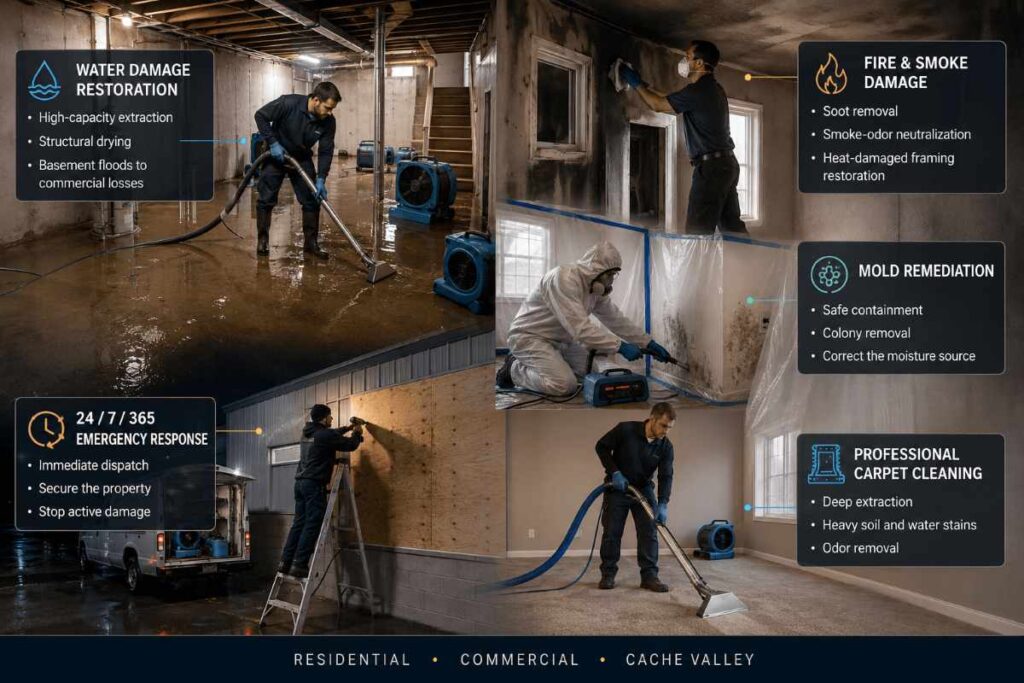
We offer a comprehensive suite of emergency services tailored to the specific needs of residential and commercial property owners in Cache Valley:
- Water Damage Restoration: Utilizing state-of-the-art water extraction and structural drying technology to handle everything from basement floods to major commercial water losses.
- Fire & Smoke Damage Restoration: Removing soot, clearing toxic smoke odors, and restoring structural framing damaged by heat and flames.
- Mold Remediation: Safely containing affected areas, removing mold colonies, and treating underlying moisture sources to prevent recurrence.
- Emergency Restoration Services: Our team is on standby 24 hours a day, 7 days a week, 365 days a year. We dispatch immediately to secure and mitigate your property.
- Professional Carpet Cleaning Services: Restoring heavily soiled, water-stained, or odor-trapped carpets using professional deep-extraction methods.
Proactive Prevention Tips for Cache Valley Property Owners
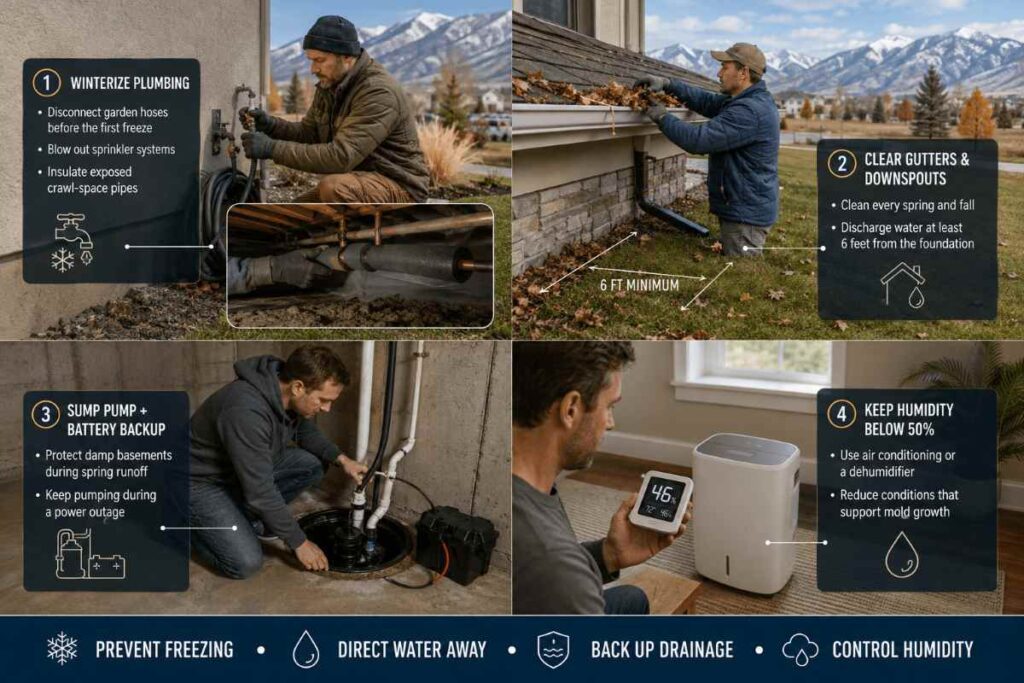
While we are always ready to respond to an emergency, the best disaster is the one that never happens. Protect your investment with these simple preventative steps:
- Winterize Exterior Plumbing: Disconnect all garden hoses before the first fall freeze. Blow out sprinkler systems and wrap exposed pipes in crawl spaces with foam insulation sleeves.
- Clear Gutters and Downspouts: Clean your gutters every spring and fall. Ensure downspouts discharge water at least six feet away from your foundation to prevent basement seepage.
- Install a Sump Pump with Battery Backup: If your basement is prone to dampness during spring runoffs, a high-quality sump pump with an auxiliary battery backup can save you thousands of dollars if the power goes out during a heavy storm.
- Monitor Your Humidity Levels: Keep indoor relative humidity below 50% using air conditioners or dehumidifiers to prevent mold spores from colonizing.
Keeping Cache Valley Safe and Restored
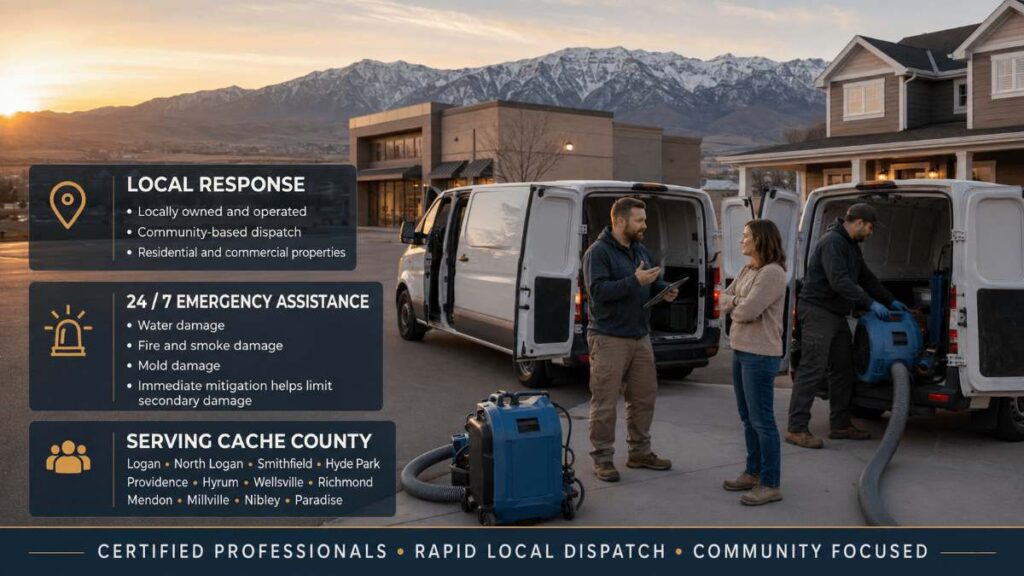
When disaster strikes, you do not want to wait for an out-of-state franchise to coordinate dispatching a crew to your door. As a locally owned and operated business, Cache Restoration responds immediately to property emergencies across our community.
We proudly serve homeowners and business owners throughout Cache County, including Logan, North Logan, Smithfield, Hyde Park, Providence, Hyrum, Wellsville, Richmond, Mendon, Millville, Nibley, and Paradise.
If you are facing water, fire, or mold damage, do not wait for secondary structural damage to set in. Contact Cache Restoration today for immediate, 24/7 emergency assistance from certified professionals who care about our Utah community.
Frequently Asked Questions
What is the purpose of a restoration company?
The primary purpose of a disaster restoration company is to clean, dry, sanitize, and fully restore properties that have suffered sudden damage from water, fire, smoke, or mold. They specialize in stopping active damage, saving salvageable building materials, and returning structures to a safe and healthy condition.
When should you call a restoration company?
You should call a professional restoration company immediately after experiencing any significant water leak, fire, flood, or upon discovering widespread mold growth. Quick intervention within the first 24 to 48 hours is critical to prevent permanent structural rot and dangerous microbial growth.
Who pays for restoration?
In most cases, property damage restoration is paid for by your property owner’s insurance policy, provided the cause of the damage is a covered loss under your policy terms. Cache Restoration works directly with your insurance provider, submitting all required documentation and moisture logs to help streamline the claim and payment process.
How do restoration companies make money?
Restoration companies bill for their specialized labor, certified expertise, and the rental use of industrial-grade drying and monitoring equipment. Because they follow industry-standard pricing guidelines (often using software like Xactimate), their bills are structured to match exactly what insurance carriers expect for covered property claims.
How long does the restoration process take?
The average drying and mitigation phase of a water damage project typically takes between 3 to 5 days, depending on the materials affected. If extensive reconstruction, drywall replacement, or structural rebuilding is required, the entire process can range from a couple of weeks to several months.
When to call a restoration company?
Call a restoration company immediately if you cannot quickly extract standing water, if smoke odor has penetrated your walls, or if mold covers an area larger than 10 square feet. Attempting to dry or clean complex damage yourself can lead to hidden rot and costly future repairs.
Who is the largest restoration company?
On a national scale, brands like Servpro and ServiceMaster are among the largest franchise networks in the industry. However, national chains often lack the personalized customer care, rapid local response times, and deep understanding of specific Utah mountain climate challenges provided by a local team like Cache Restoration.
How much does a restoration company make a year?
Annual revenue for a restoration company varies wildly based on location, staff size, and local climate events. While small local operators may earn several hundred thousand dollars annually, larger multi-regional companies can generate millions of dollars, especially when responding to widespread natural disasters.
Can mold be fully removed from a home?
While it is impossible to eliminate all mold spores from an indoor environment, professional remediation safely reduces mold concentrations back to normal, healthy background levels. This is achieved by sealing off the affected area, running HEPA filtration, and correcting the underlying moisture source that allowed the mold to grow.
What is structural drying?
Structural drying is the scientific process of removing trapped moisture from building materials like wood framing, concrete blocks, and subfloors using controlled temperature, high-velocity airflow, and industrial dehumidifiers. This process is monitored daily with professional moisture meters to ensure materials return to their normal dry standard.