Emergency Water Damage Response & Drying: A Property Owner’s Guide
Key Takeaways
- The 24-to-48-Hour Window: Mold can begin growing within 24 to 48 hours of water intrusion. Immediate extraction is critical to protect indoor air quality.
- Hidden Moisture is the Real Enemy: Standing water is easy to see, but water trapped behind drywall and under subfloors requires specialized detection tools to find and extract.
- Local Conditions Matter: Cache County’s seasonal shifts – from frozen winter plumbing to sudden spring snowmelt – demand tailored restoration strategies.
- Professional Equipment Wins: Standard household fans cannot pull deep moisture out of structural framing; industrial air movers and low-grain refrigerant dehumidifiers are necessary.
The Reality of Property Water Damage: Why Seconds Count
Discovering a pool of water creeping across your living room ceiling or blanketing a commercial warehouse floor is an incredibly stressful experience. Whether it is a burst pipe in the middle of a freezing Northern Utah night or a supply line failure while you are away from your business, property damage disrupts your life and threatens your investment.
When water invades a building, the clock starts ticking immediately. Water is progressive; it migrates rapidly through drywall, wicks up wood baseboards, and saturates subfloors. For both homeowners and business owners in Cache County, understanding how to respond in those first few critical hours can mean the difference between a simple, straightforward drying job and a massive, expensive structural reconstruction project. Knowing when to call for professional emergency restoration services is the first step toward getting your property – and your peace of mind – back to normal.
Water Damage Problem in Cache County
Water damage happens for dozens of reasons, but in our region, geographic and seasonal conditions play a massive role in how and when disasters strike.
Common Causes of Water Intrusion
- Winter Freeze-Thaw Cycles: Northern Utah winters are notoriously harsh. When temperatures plunge in Logan or Smithfield, water inside unprotected exterior lines or crawlspaces freezes, expands, and splits plumbing pipes. The real disaster happens hours or days later when the ice thaws and pours hundreds of gallons of water into wall cavities.
- Spring Snowmelt and Basement Flooding: As the heavy snowpack from the Bear River Mountains melts rapidly in the spring, the local water table rises. This sudden influx of groundwater frequently overwhelms residential sump pumps, leading to sudden basement flooding.
- Sudden Appliance Failures: Sump pump malfunctions, ruptured washing machine braided hoses, and failing water heaters can strike at any time of year, affecting both residential homes and commercial spaces.
- Summer Thunderstorms: Brief but intense summer downpours can cause localized flash flooding, sending surface water rushing toward foundation walls, overflowing roof gutters, and filling window wells.
Seasonal Risk Summary Table
| Seasonal Risk | Primary Property Impact |
| Winter Cold | Frozen and burst plumbing pipes, structural ice dams |
| Spring Thaw | Sump pump failures, rising groundwater, flooded basements |
| Summer Storms | Flash floods, roof leaks, overloaded gutter systems |
What Are the First Steps After Water Damage?
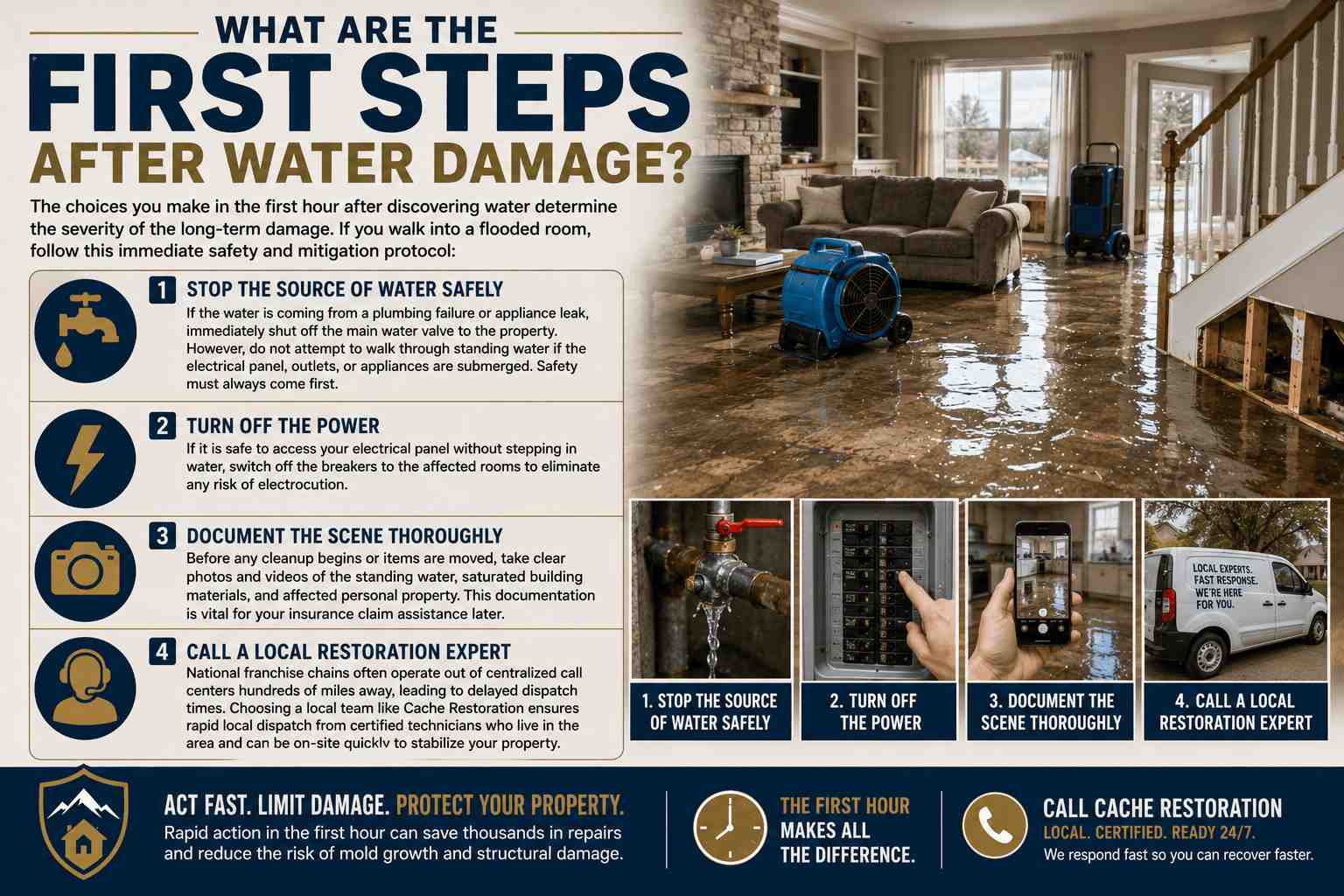
The choices you make in the first hour after discovering water determine the severity of the long-term damage. If you walk into a flooded room, follow this immediate safety and mitigation protocol:
1. Stop the Source of Water Safely
If the water is coming from a plumbing failure or appliance leak, immediately shut off the main water valve to the property. However, do not attempt to walk through standing water if the electrical panel, outlets, or appliances are submerged. Safety must always come first.
2. Turn Off the Power
If it is safe to access your electrical panel without stepping in water, switch off the breakers to the affected rooms to eliminate any risk of electrocution.
3. Document the Scene Thoroughly
Before any cleanup begins or items are moved, take clear photos and videos of the standing water, saturated building materials, and affected personal property. This documentation is vital for your insurance claim assistance later.
4. Call a Local Restoration Expert
National franchise chains often operate out of centralized call centers hundreds of miles away, leading to delayed dispatch times. Choosing a local team like Cache Restoration ensures rapid local dispatch from certified technicians who live in the area and can be on-site quickly to stabilize your property.
The Mechanics of Structural Drying
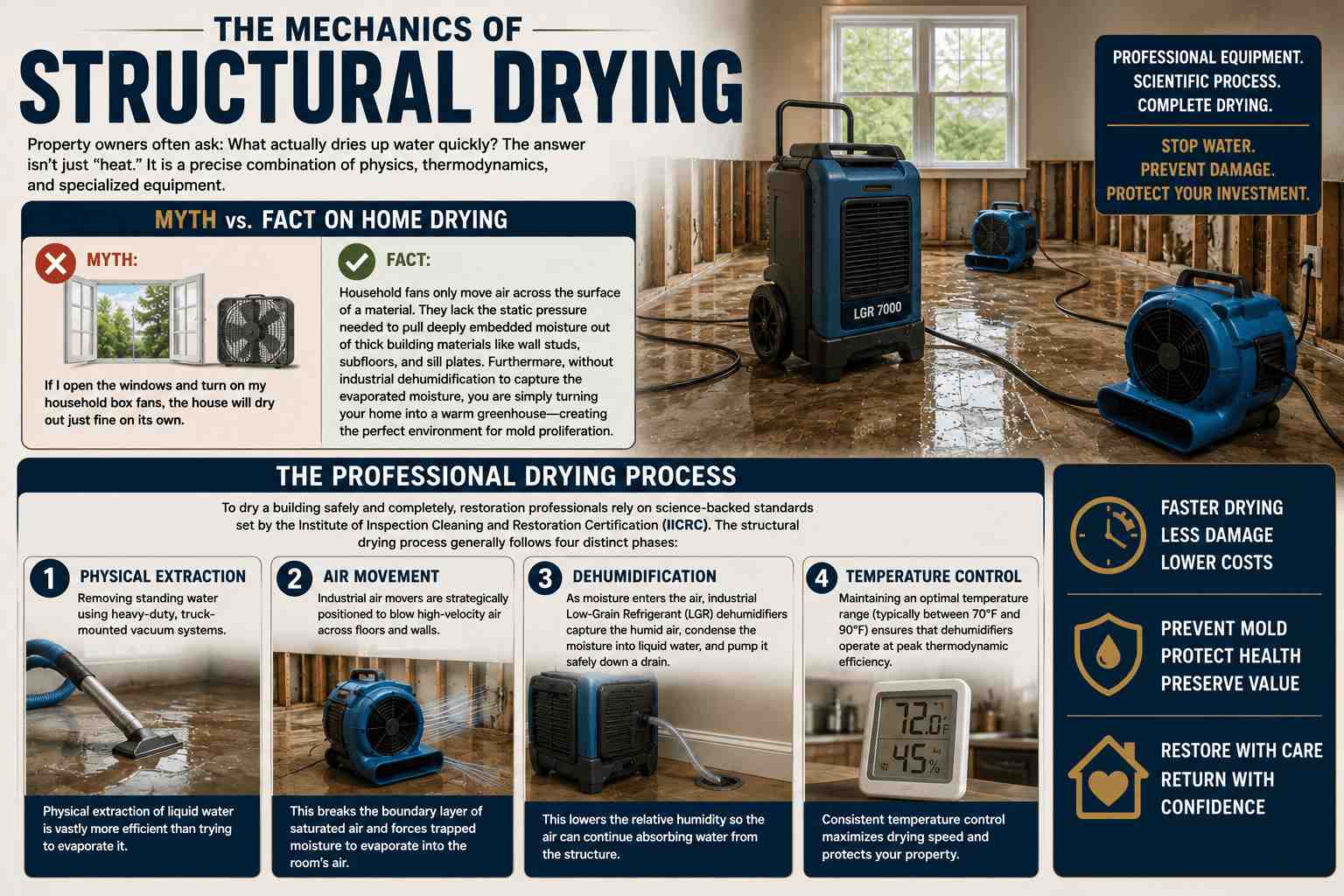
Property owners often ask: What actually dries up water quickly? The answer isn’t just “heat.” It is a precise combination of physics, thermodynamics, and specialized equipment.
Tip: Myth vs. Fact on Home Drying
Myth: If I open the windows and turn on my household box fans, the house will dry out just fine on its own.
Fact: Household fans only move air across the surface of a material. They lack the static pressure needed to pull deeply embedded moisture out of thick building materials like wall studs, subfloors, and sill plates. Furthermore, without industrial dehumidification to capture the evaporated moisture, you are simply turning your home into a warm greenhouse – creating the perfect environment for mold proliferation.
The Professional Drying Process
To dry a building safely and completely, restoration professionals rely on science-backed standards set by the Institute of Inspection Cleaning and Restoration Certification (IICRC). The structural drying process generally follows four distinct phases:
- Physical Extraction: Removing standing water using heavy-duty, truck-mounted vacuum systems. Physical extraction of liquid water is vastly more efficient than trying to evaporate it.
- Air Movement: Industrial air movers are strategically positioned to blow high-velocity air across floors and walls. This breaks the boundary layer of saturated air and forces trapped moisture to evaporate into the room’s air.
- Dehumidification: As moisture enters the air, industrial Low-Grain Refrigerant (LGR) dehumidifiers capture the humid air, condense the moisture into liquid water, and pump it safely down a drain. This lowers the relative humidity so the air can continue absorbing water from the structure.
- Temperature Control: Maintaining an optimal temperature range (typically between 70°F and 90°F) ensures that dehumidifiers operate at peak thermodynamic efficiency.
DIY vs. Professional Restoration
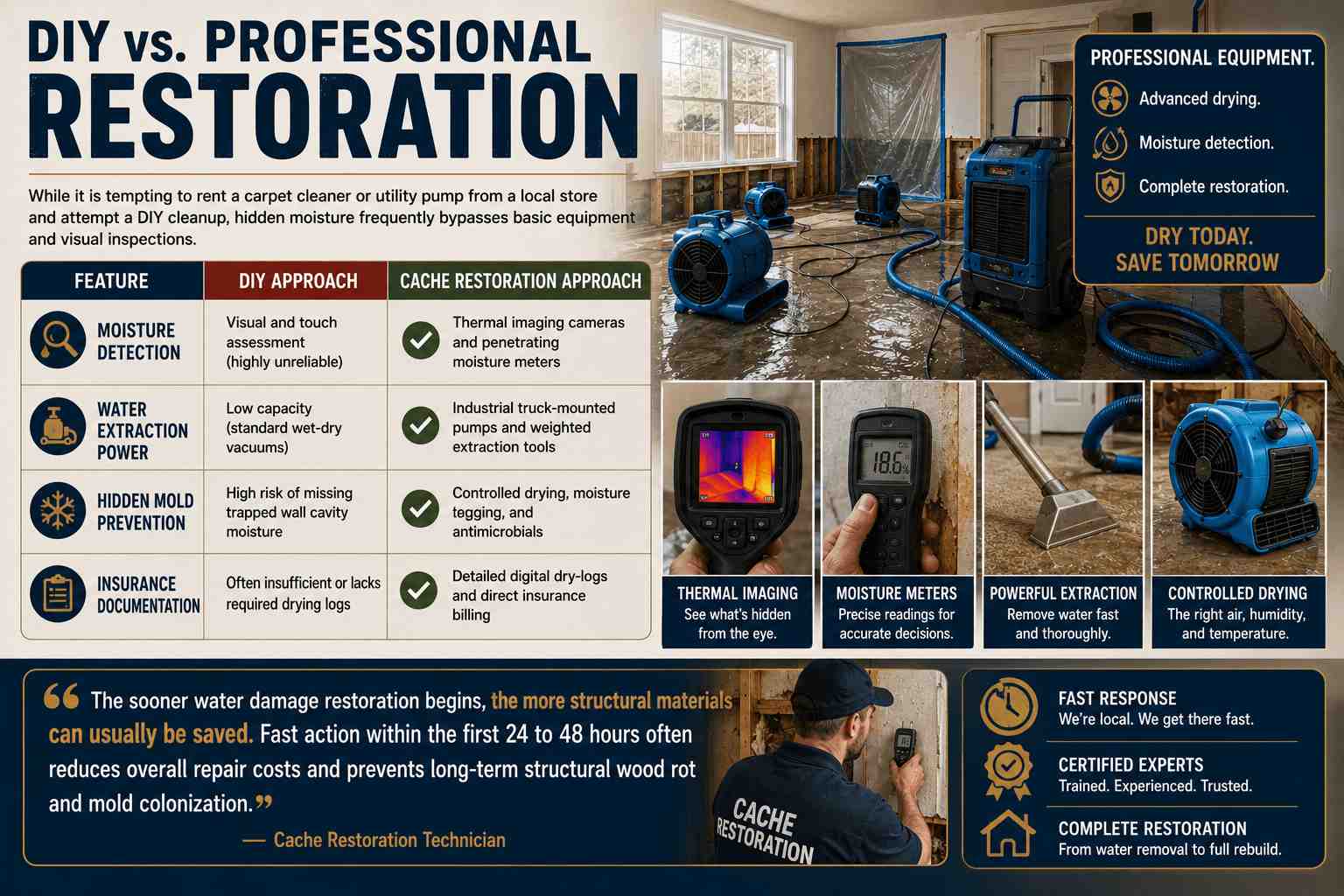
While it is tempting to rent a carpet cleaner or utility pump from a local store and attempt a DIY cleanup, hidden moisture frequently bypasses basic equipment and visual inspections.
Feature Comparison Table
|
Feature |
DIY Approach | Cache Restoration Approach |
| Moisture Detection | Visual and touch assessment (highly unreliable) | Thermal imaging cameras and penetrating moisture meters |
| Water Extraction Power | Low capacity (standard wet-dry vacuums) | Industrial truck-mounted pumps and weighted extraction tools |
| Hidden Mold Prevention | High risk of missing trapped wall cavity moisture | Controlled drying, moisture logging, and antimicrobials |
| Insurance Documentation | Often insufficient or lacks required drying logs | Detailed digital dry-logs and direct insurance billing |
Expert Quote: Cache Restoration Technician
“The sooner water damage restoration begins, the more structural materials can usually be saved. Fast action within the first 24 to 48 hours often reduces overall repair costs and prevents long-term structural wood rot and mold colonization.”
– Cache Restoration Technician
Cache Restoration Services
When disaster strikes your home or business, Cache Restoration provides a comprehensive suite of property recovery services designed to minimize downtime and protect your property asset value:
- 24/7 Emergency Restoration: Disasters don’t stick to standard business hours. Our local teams are ready to respond day or night.
- Water Damage Restoration: Complete extraction, science-based structural drying, and continuous moisture monitoring from certified professionals.
- Fire & Smoke Damage Restoration: Removing soot, clearing toxic smoke odors, and repairing structural components after fire incidents.
- Mold Remediation: Safely isolating, containing, and removing mold colonies according to EPA and CDC guidelines if moisture was left untreated.
- Professional Carpet Cleaning Services: Using deep-extraction equipment to clean, sanitize, and save soaked carpets whenever structurally salvageable.
Proactive Tips to Prevent Water Damage
Tip: Essential Preventative Maintenance
- Winterize Exterior Plumbing: Before the freezing Utah winter sets in, disconnect all general garden hoses and turn off the interior shutoff valves to exterior spigots.
- Inspect Sump Pumps Every Spring: Pour a bucket of water into your sump pump basin each March to ensure the float switch activates the pump before the spring snowmelt begins.
- Keep Roof Gutters Clear: Clean your gutters every autumn. Clogged gutters allow water to back up under shingles, causing ice dams in the winter and attic leaks during summer storms.
Conclusion: Trust Your Local Recovery Experts
Water damage can feel overwhelming, but you do not have to navigate the recovery process alone. Acting quickly and choosing a local partner avoids the long wait times of national franchises and guarantees a tailored, neighborly approach to your home’s recovery.
Cache Restoration proudly serves homeowners and businesses throughout Cache County, including Logan, North Logan, Smithfield, Hyde Park, Providence, Hyrum, Wellsville, Richmond, Mendon, Millville, Nibley, Paradise, and surrounding communities.
If your property has experienced water intrusion, don’t wait for mold to take root. Contact Cache Restoration immediately for trusted, certified 24/7 emergency restoration services.
Frequently Asked Questions
How dangerous is mold after flooding?
According to the Centers for Disease Control and Prevention (CDC), damp indoor environments promote the growth of mold, which can cause nasal stuffiness, throat irritation, coughing, and accelerated asthma symptoms. If water damage isn’t dried properly within 48 hours, mold spores will germinate behind walls, hurting indoor air quality long after the visible water is gone.
Can soaked carpets be saved?
It depends entirely on the category of water. If the water comes from a clean source (Category 1, like a clean water supply line), the carpet and pad can often be dried in place using professional subsurface extraction tools. However, if the water comes from a sewer backup or outdoor surface flooding (Category 3, “black water”), the carpet and padding are biohazards and must be removed and replaced for your safety.
Does homeowners insurance cover restoration?
Most standard homeowners and commercial property policies cover sudden and accidental water damage (like a burst pipe or water heater failure). They generally do not cover gradual damage caused by unresolved long-term maintenance issues or external rising ground floods unless you have a specific flood policy.
How quickly should I begin restoration after water damage?
You should begin the water extraction and drying process within 24 to 48 hours of the initial water intrusion. This narrow time window is critical because mold spores can germinate and begin damaging structural building materials within 48 hours in damp conditions.
Does water damage happen immediately?
Yes, water damage begins immediately upon contact, as drywall, wood framing, and flooring instantly absorb water like a sponge. Over the following hours and days, this absorbed moisture causes materials to swell, warp, delaminate, and eventually grow structural mold.
How do you dry out a house after water damage?
Drying a house requires a strategic three-step process: complete mechanical extraction of standing water, high-velocity air movement to vaporize trapped moisture from building materials, and heavy-duty industrial dehumidification to extract that moisture out of the air.
How long does it take for water damage to dry out?
On average, a standard water-damaged room takes between 3 to 5 days to dry completely using industrial restoration equipment. The exact timeline depends heavily on the types of materials saturated, how long the water sat, and the local indoor humidity levels.
What happens if I wait too long to call a restoration company?
Waiting too long allows water to wick deeply into structural framing, leading to wood rot, warped flooring, ruined drywall, and widespread mold growth. Additionally, prolonged delays can cause your insurance company to deny coverage due to neglected property maintenance.
Does homeowners insurance cover water damage restoration?
Most homeowners insurance policies cover sudden and accidental water damage, such as a ruptured appliance hose or a burst frozen pipe. However, gradual damage caused by unresolved maintenance issues, or external rising ground floodwaters, typically requires a separate, specific flood policy.
How dangerous is hidden moisture inside walls?
Hidden moisture inside wall cavities is highly problematic because it ruins structural integrity and fosters hidden mold colonies completely out of sight. Over time, this deteriorates indoor air quality and causes chronic respiratory irritation for building occupants.
Why shouldn't I just use a regular shop vacuum to clean up water?
A standard household utility vacuum lacks the extraction power, water capacity, and specialized lift required to pull deep water out of carpet padding and subfloors. It leaves behind significant hidden moisture that leads directly to mold growth.
What is the difference between a local restoration company and a national chain?
A local company like Cache Restoration provides faster response times because our technicians are already stationed within the community, which is crucial during an emergency. Furthermore, local companies possess intimate knowledge of regional weather patterns, like Utah winter freezes, and provide personalized customer care.
When is water considered safe to dry, and when must materials be thrown away?
Water from clean plumbing leaks (Category 1) can usually be safely dried in place along with the surrounding materials. Water from outdoor flooding or sewage backups (Category 3) contains hazardous bacteria and pathogens, meaning porous materials like carpets, padding, and drywall must be removed and replaced.